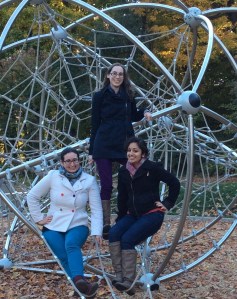
 On Nov. 29th, the three co-directors of Staging Our Histories (Arpita Bajpeyi, Sinead Cox and Marie-Anne Gagnon) met with colleague Christina Parsons via the magic of the internet to talk about the concept and their expectations of the event. You can catch up with Part I of the the discussion here.
Christina Parsons: Do you feel that you may encounter some contention between people who have experienced certain histories differently?
Marie-Anne Gagnon: There are so many pages of history to choose from that it would be a big coincidence. But if so, I don’t think that would be a problem, but rather a great opportunity for exchange and fostering understanding.
Arpita Bajpeyi: Absolutely! Part of the event will be opening up the floor so that the audience and performers can have those conversations in a positive, constructive space. But I think the very nature of the performance implies each history will be a personal interpretation.
Sinead Cox: There will be the talk-backs. And as much as performance can be very cathartic and personal for a performer when they’re talking about history, I think an audience can also have a very visceral reaction, positive or negative. The day we had our performances [at Carleton], I remember it being very draining: they were incredible, but it was emotional. I think performance is great for engaging you intellectually and also getting you right in the gut.
Marie-Anne: We have left the theme very open-ended so that people can bring forward whatever project they would like. In future years (if we are lucky enough to make this happen again!) it could be interesting to narrow the subject to see different interpretations of the same topic
Christina: Very true, it would be great to see many facets of the same topic.
Marie-Anne: As Sinead was saying, in our experience, people chose very personal topics, that had to do with their own history or that of their family.I guess we wanted to see that happen again. Because it was so powerful.
Arpita: Those are the stories that were the most powerful.
Sinead: It’s interesting how commonalities pop up even when the topic is broad. I think patterns emerge. Like grandparents.
Marie-Anne: Did you know genealogy is the most researched thing at LAC? Just proves that people care about where they personally come from. Henry VIII can seem rather far.
Christina: Being able to share personal stories on a larger scale can be very affirming to someone who does not usually have that platform.
Sinead: Yes! And I think as much as [submissions] can be about a personal history, they can also be about NOT having that history. Of being divorced or alienated from your history, or conflicted about it.
Arpita: And that is something we’re hoping to provide, for sure. A space for histories that are typically overlooked or ignored because of the way that they are told, or because of who is telling them. And those can be incredibly powerful pieces too.
Marie-Anne: But I suspect we might also see performances about parts of history that interest the participants, even if they are not directly connected.
Sinead: What speaks to people isn’t always directly close, for sure. Maybe someone feels very connected to and passionate about Henry VIII! As long as they’re telling that story in a new way, we’d be interested.
Marie-Anne: Most historians study not their own culture. Part of being a historian is having a curiosity for what you don’t personally know.
Christina: Are you making an effort to include indigenous or counter-colonial narratives?
Arpita: I think the three of us definitely gravitate towards those kinds of narratives, for various reasons. I’d be surprised if none of them appear in the program!
Marie-Anne: Indeed.
Sinead: I hope so. Attention all of you with counter-colonial narratives: please submit!
Arpita: That’s part of the fun of this experiment. Seeing what comes our way.
Christina: What mediums are available? For instance, will you have audio/visual equipment?
Arpita: We will provide most equipment, unless it’s highly specialized.
Sinead: That’s a good question! We’re definitely interested in film and multimedia. So we will try to accommodate the proposals we accept within the limits of the venue.
Marie-Anne: We should probably mention how long the performances should be, and how long the evening will be.
Arpita: The evening will begin at 7:30, and performances and talk-backs will run until 9:30, after which there will be a reception. Performances should run between 5-20 minutes.
Christina: Also, for posterity, what day is it?
Arpita: Sunday May 31.
Marie-Anne: If you’re coming to Ottawa for the CHA AGM, please drop by! [It will be] an awesome, mind blowing, intellectually stimulating show. (You don’t need to include that. Just a fact.)
Sinead: It may need to be the title!
Keep an eye out for exciting news and updates about Staging Our Histories in the days to come, including the official announcement of our venue! Many thank yous to Christina Parsons for her time, and for her thoughtful questions as our moderator. You can hear much more from Christina in her upcoming podcast, H is for History and read her work at History Watch.
You’ve read how the co-directors envision the outcome of Staging Our Histories, but the reality will be up to you, and the challenging, surprising and powerful work you submit by January 9th! Read more about the submission guidelines here.
If you have any queries for Arpita, Marie-Anne or Sinead before you submit, email us at StagingHistories@gmail.com.

 STAGING OUR HISTORIES