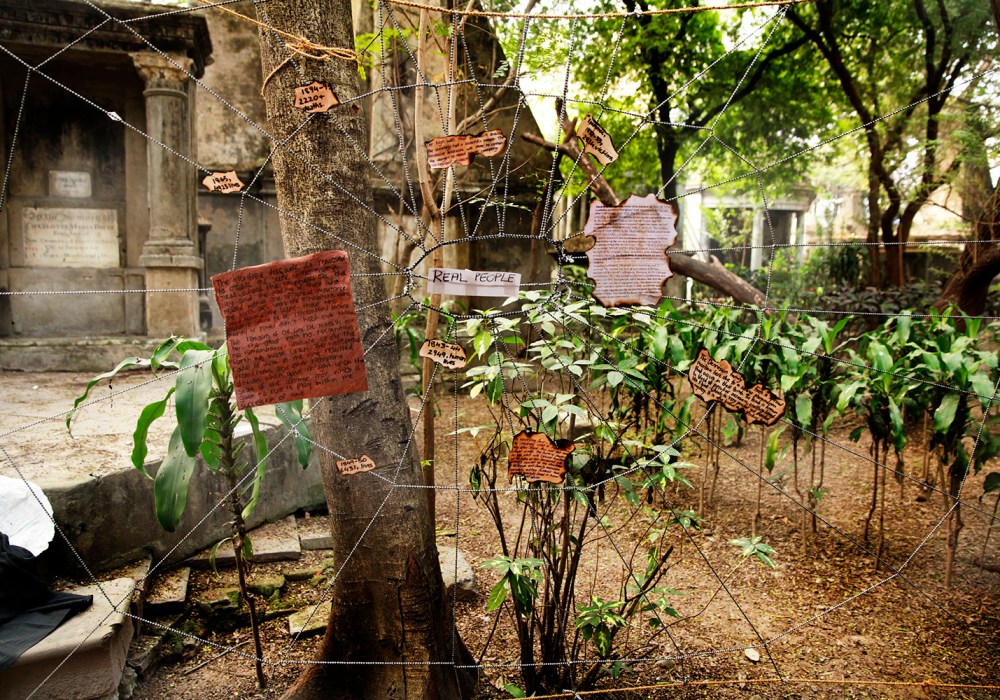
Photo credit: Nazes Afroz

Students Bring History Alive in Kolkata’s South Park Street Cemetery

Last December, Think Arts and students from schools across Kolkata, India, opened a temporary exhibition at the South Park Street Cemetery. In the coming weeks, a new batch of students will have the opportunity to bring history to life in their own way in the same space. Read on to learn more about the project. (Feature image photo credit: Nazes Afroz)

The South Park Street Cemetery in Kolkata is one of those iconic spaces in the postcolonial world that whispers to passersby of a very different time and place. The weathered, mossy stones now interrupted by trees and plant life that have had centuries to stretch their limbs invite you see the cemetery as an artefact of the past with little bearing on the bustling city outside its walls. Though largely forgotten by residents of Kolkata, it still has a pull for some people, like Ruchira Das. “Every time I visited the South Park Street Cemetery in Calcutta, I have been moved by the gravity of the place. Not having grown up in Calcutta, I discovered this fascinating place quite by accident, during one of my visits to the city.”

But Das, founder of Think Arts – an organization geared to engage children with the world around them through the arts, in unconventional ways – was also keenly aware of the kind of history that the cemetery represented in the city’s past. “After I moved to Calcutta a few years ago,” she writes, “I got a chance to spend a lot more time at SPSC and was struck by the fact that the cemetery was in use during one of the most interesting periods of Calcutta’s history (1767 – 1830) – it was during this period that Calcutta was named the capital of British India, the Asiatic Society was founded, the Bengal Renaissance took its roots and the city saw several such significant events.”

Upon realizing that many of the city’s residents, including children like those at a school just a couple hundred meters away from the cemetery, had never entered the space, Das approached the Christian Burial Board, under whose management the cemetery fell.  The board mirrored her concern about the lack of public engagement with the space.

“Paradoxically enough, it was in a cemetery that the pages of history came alive for all of us.”

Das proposed a project wherein school children would spend six months researching and exploring the narratives buried in the site to develop an exhibition called ‘Our History, Their Times.’ The project was designed to encourage students to think about the spaces and stories that surrounded them through art forms they were familiar with: “Retracing a city’s history and presenting it using their [students’] forms of expression can be an involved, exciting activity with a tremendous scope for learning – learning outside textbooks.” For Das, the installations, which ran from the 7th to the 13th of December, 2015, represented a critical understanding and response to the histories to be found in the South Park Street Cemetery – an engagement that was as much about the form as the content in the physical pieces themselves. This emphasis on the value of art as an active site of learning is something Das believes in firmly, and was a driving factor behind the project. In her concept note on the project, she expressed a need to ensure “that the youth is involved in critical thinking – of investigating history, discovering stories, examining perspectives and questioning the accepted.”

The students, grades eight to eleven, came from schools across the city. They were captivated by the romance of the cemetery from the start. Reflections on their first visit to the site highlighted the picturesque beauty of the space, but also revealed a curiosity of the stories that lay behind tombstones and beneath their feet. “I thought that the cemetery was exquisite, but beauty certainly isn’t skin deep,” wrote one student. “The visit gave me the opportunity to make my way deeper into the stories of the people who lay there, and introspect on the lives that once were. It certainly had a great impact on me.”

The project was a huge success, both among participants and with members of the general public who poured visited the exhibition last December. Over the six months of the project, students explored the histories of individuals associated with and interred at the site, as well as those of the nameless Indians and Europeans who lived in Calcutta during that period. Working in groups with help from visual artist Nobina, and professor of English, Dr. Sudip Bhattacharya, students produced a number of different responses to the space, and explored various themes to bring the history of their city to life within the walls of the cemetery. Sunita Biswas, a teacher at Modern High School for Girls was as enthusiastic as her students about the project: “It’s been a wonderful learning experience for the entire team…teachers and students. It gave them a better understanding of Kolkata and its past. Paradoxically enough, it was in a cemetery that the pages of history came alive for all of us.”

Thanks to Ruchira Das and her students, the South Park Street Cemetery was bustling with live bodies for the duration of the exhibition, which brought in residents of the city from all walks of life who were curious about the colourful displays scattered between the trees and tombstones. “Our History, Their Times” was such a success that the Christian Burial Board has asked Das to facilitate the project again this year with a new group of schools. They will be starting their research and work on their projects in the coming weeks, and open up the cemetery gates for a second exhibition in December, 2016.

You can learn more about Ruchira Das and her organization, Think Arts on her Facebook page, http://www.facebook.com/thinkartskolkata/.

Two Days until Staging Our Histories! Why we Can’t Wait

Excited for history to take the stage? You’re not the only one. Don’t take our word for it; check out why Ottawa, as well as the arts & academic communities at large, is psyched for history (a)live and off the page THIS SUNDAY! Get your tickets

Tweet us why YOU are excited for Staging Our Histories:  @stagehist

7 Reasons to Experience History off the Page

Although math is not her strong suit, Co-Director Sinead Cox lists her top seven reasons to snag tickets for History (a)Live: 

ONE: THE TALENT                                                                                  StaginOurHistories

Our performers are multi-talented artists, storytellers, poets and filmmakers, and they actually constitute eight great reasons to be at the National Arts Centre on May 31st. Staging Our Histories brings this group of diverse amateur and professional artists together in the same room for the first (and probably only) time. Their artistic voices and perspectives on history are entirely original and distinct, but their pieces complement each other by asking similar questions about identity, memory and legacy.

TWO: IT’S NOT THE HISTORY YOU READ IN SCHOOL

Our organizers are interested in how stories and memories change across different mediums, and how performance can be a powerful platform for unwritten or unrecorded histories. Each of the seven histories presented on stage on May 31st is personal and revelatory, and interrogates how we share and forget the past on and off the page.

THREE: IT’S A PARTY

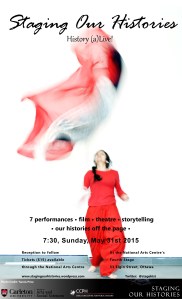
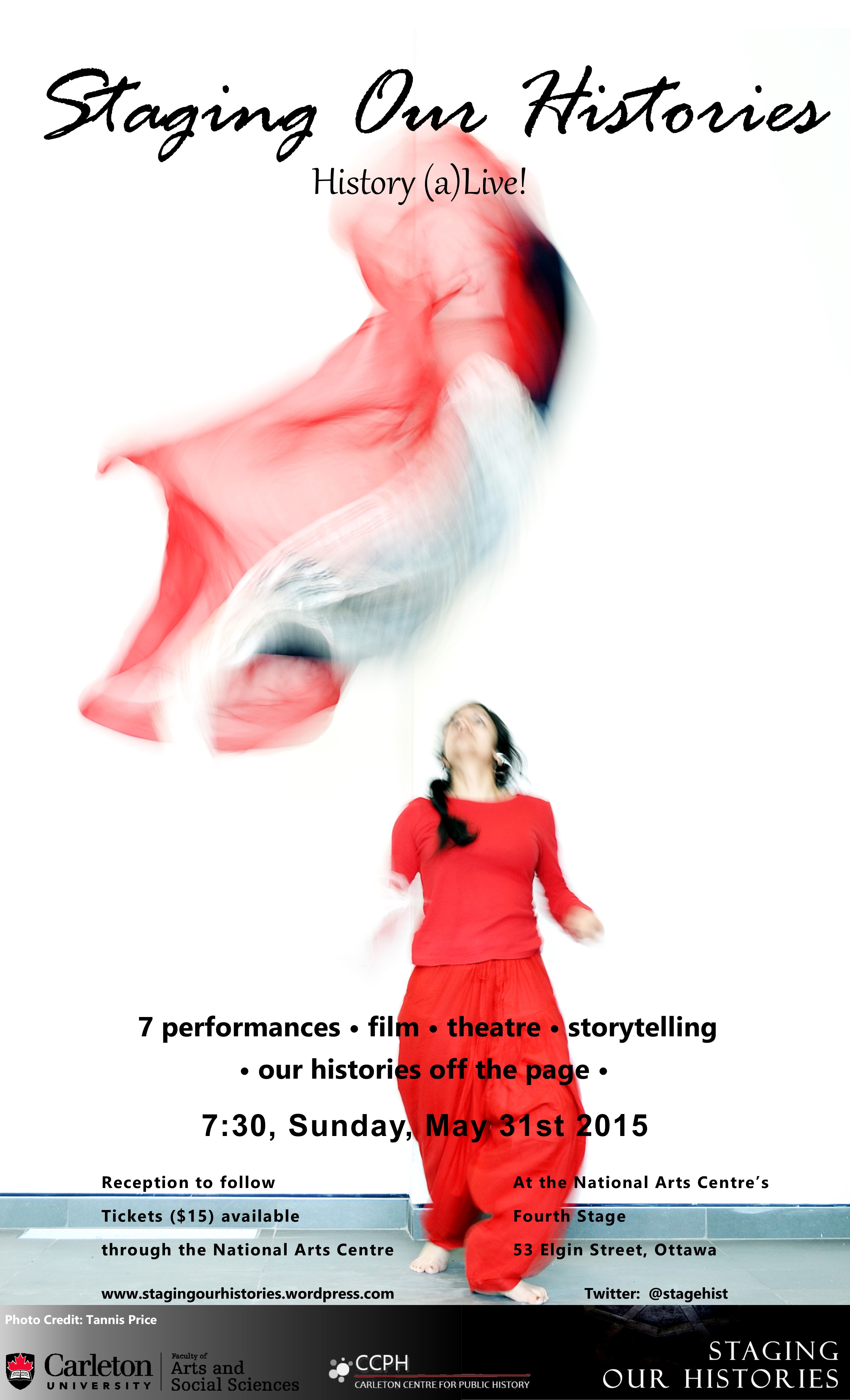
SOH Poster (1)

Ticket-holders for Staging Our Histories are invited to a reception following the performances. There will be refreshments, snacks, and a chance to mingle with the performers and organizers.

FOUR: YOU CAN BE PART OF HISTORY

Staging Our Histories is a conversation, not a lecture. The evening’s discussion of performative histories will extend beyond the stage, as host Adrian Harewood moderates talkbacks between the artists and the audience. We hope theatre-lovers, students, historians, and just about everyone else, will be inspired by the convergence of history and performance, as we continue to be.

FIVE: THERE’S A CHANCE TO GET IN FOR FREE!

unnamed

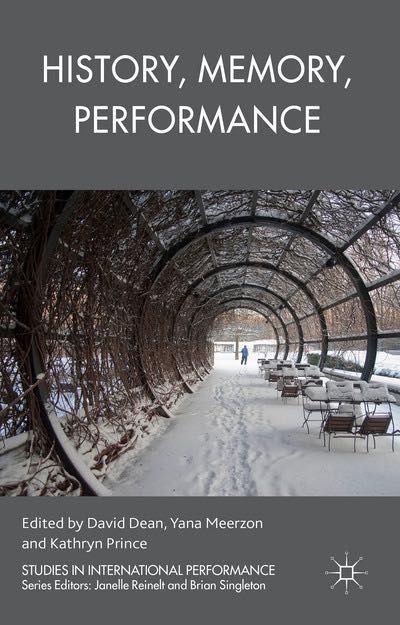
You can win tickets to Staging Our Histories, and a copy of History, Memory, Performance, just by tweeting your favourite history experience to @stagehist with the contest hashtag #mylivehistory. 

SIX: RIGHT TIME, RIGHT PLACE

Staging Our Histories happens at ‘Canada’s Stage’, the National Arts Centre, in lovely downtown Ottawa. It’s conveniently close if you’re in town that week to attend the 2015 Congress of the Social Sciences and Humanities at the University of Ottawa, or you’re taking part in the Walk for Reconciliation, also on May 31st.

SEVEN: THE (HISTORY) A(LIVE) TEAM

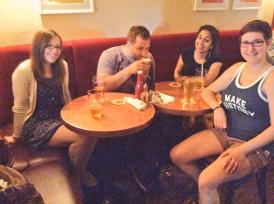
CEGLjzPWgAA1Fh9 (1)

Once again, this is six good reasons for the price of one. The Staging Our Histories organizers are volunteers motivated by the desire to expand public access to unconventional and thought-provoking histories. The co-directors and core volunteers are all recent grads or current students of Carleton University’s history program; they’re also keen, passionate about history, and a lot of fun to hang out with– so look for us at the reception after the show.

If you care to join us for a night of extraordinary performances, you can GET TICKETS NOW at the NAC’s box office.

Need another reason? Contact the co-directors with any questions at staginghistories@gmail.com!

#MyLiveHistory: Tweet your kind of history, Win Free Tickets

WIN by sharing your favourite experiences of history off the page!

Become a #twitterstorian and tweet original photos or video links of your favourite way to  experience history a(live) to @StageHist with the contest hashtag #mylivehistory, before May 29th.

Contest Details: Win FREE tickets to Staging our Histories & a copy of new book History, Memory, Performance

Check out examples from our co-directors!

#MyLiveHistory: Tweet @StageHist & Win!

All the world’s a stage. What’s yours?

How do you prefer to experience stories? What captures your imagination and gets you excited about the past?  Is it museum programming? Movies? Video games? A family member that tells a great tale? A nice commemorative plaque, maybe? Something a little unconventional? How have you shared your own unique perspective on history with others? Show us! Tweet your photos of history (a)live to @Stagehist.

Staging Our Histories spotlights the ways histories are talked about, embodied, represented, remembered and forgotten off the page and outside of the classroom. Before our performers take the stage at the National Arts Centre on May 31st to express their thought-provoking histories through theatre, storytelling, film and poetry, we want to hear from you!

WIN by sharing your favourite experiences of history off the page!

Become a #twitterstorian and tweet original photos or video links of your favourite way to  experience history a(live) to @StageHist with the contest hashtag #mylivehistory, before May 29th.

On performance night, participants with the most retweets* win two FREE tickets to Staging Our Histories and a copy of History, Memory, Performance, generously donated by editor David Dean, to be presented at the reception following the night’s performances on May 31st. The runner-up will also receive a pair of tickets (kindly sponsored by individual donors).

unnamed

Contest Details

Eligible tweets will include a photo or linked video of an activity, performance, artwork, location, person etc that inspired you to experience or reflect upon the past and/or its legacy in the present. Everything from playing a video game that takes place in an alternate past, to a selfie on a historic walking tour is welcome. Tweets may be in French or English.

To be considered for prizes, all tweets must  include Staging Our Histories’ twitter handle (@stagehist) and the contest hashtag #mylivehistory. If you are tweeting about the work of another individual or cultural/heritage organization, we encourage you to tag them as well.  Entrants are welcome to submit multiple tweets. The contest ends midnight on the night of May 28th.

@Stagehist will retweet all eligible tweets. The  two tweets to receive the most total retweets** before May 29th will be the winners!*

Our first prize winner receives a copy of History, Memory , Performance, edited by Prof. David Dean (value $90) and two FREE tickets to Staging Our Histories (value $30+ tax). The runner-up receives two free tickets (value $30+ tax).  These prizes can be collected on Staging Our Histories’ performance night, May 31st at the National Arts Centre.***

The histories you tweet can be untold, unofficial and unexpected, but please make sure they are also sensitive, thoughtful and respectful. Any tweets of a graphic nature or those deemed offensive, hateful or inappropriate by the co-directors of Staging Our Histories are disqualified from consideration for the contest and will not be retweeted by @stagehist.

* In the event of a tie, Staging Our Histories’ organizing team will act as judges to vote for the winning tweet and the runner-up. The organizers’ and performers’ tweets are not eligible to win the prizes.

** For the purposes of this contest, we will count only RTs, not quoted tweets, MTs or favourites.

*** The winner must provide a full name & contact information by private message/email to collect his/her prize on May 31st.

The Box Office is Open!

On May 31st, the National Arts Centre`s Fourth Stage welcomes theatre-lovers, film buffs, students, historians, twitterstorians, and anyone who has shared or appreciated history and memory off the page.

Staging Our Histories tickets are officially on sale at the National Arts Centre’s box office! Get yours today, and be part of history a(live). A $15 ticket includes seven performances, talk-backs with host Adrian Harewood, and a reception.

SOH Poster (1)

Staging Our Histories is a not-for-profit event organized by three volunteer co-directors, and supported by the Carleton Centre for Public History, Carleton University’s History Department and Carleton University’s Faculty of Arts and Social Sciences-Office of the Dean.

Staging Our Histories at the National Arts Centre Box Office

Does the way we tell the story change our understanding of history?

Join the performers of Staging our Histories May 31st at the National Arts Centre to witness seven performances that bring new perspectives to the past and invite the audience to interact with history. Check out Staging Our Histories on the NAC’s website in English and French.

Eight powerful stories told via film, theatre, poetry and oral storytelling will illuminate the past and its impact on the present for one evening in Ottawa. At Staging Our Histories, creative storytelling will bring the origins of a local landmark to life, film and theatre will investigate the memories contained in a grandmother’s home remedies, and poetry will express the lived experience of colonial legacies, among other performances.

And mark your calendars! Tickets for Staging Our Histories are officially on sale at the National Arts Centre’s box office on April 6th at 10 am!

Tickets on Sale NOW!

Get tickets for the first-ever Staging Our Histories today! 

May 31st, 7:30 pm                       National Arts Centre, Fourth Stage

CLICK HERE FOR TICKETS via Ticketmaster 

SOH Poster Image

We’re pleased to announce that you can now reserve your seat at the National Arts Centre’s Fourth stage to experience ten talented artists embodying the past and its implications in the present through storytelling, film, theatre and poetry. The evening will additionally feature talk-backs between audience and artists moderated by host Adrian Harewood.

Be a part of our first year and participate in a dialogue regarding how history is told and how it is received. Our audience is a significant and valued part of an interactive, one-of-a-kind evening of live performances and conversation. A ticket to Staging Our Histories grants you the chance to see eight extraordinary works, an opportunity to address the artists, and an invitation to an end-of-the-night reception at the National Arts Centre.

Staging Our Histories’ Venue & a First Glimpse at our Poster!

Our co-directors are pleased to announce that the very first Staging Our Histories will take place at the National Arts Centre‘s Fourth Stage, 53 Elgin St, Ottawa at 7:30pm.  After the evening’s performances and interactive talk-backs with the audience moderated by host Adrian Harewood a short reception will follow in the same location.

We’d like to extend our gratitude to Tannis Price for collaborating with co-director Arpita Bajpeyi on our eye-catching poster.

Poster-1

Angela Wright

Angela Wright began writing poetry at the age of fifteen, using it as a way to
explore the world around her. The biggest influence on her poetry has been her
training as a historian, both at the undergraduate and graduate level. Her poems
often transcend temporal boundaries and demonstrate that, because of the
fluidity of time, events do not occur in a vacuum but rather reverberate across
generations.

For Staging Histories, Angela will perform a collection of poems that explores the
often-tenuous experience of people of African descent in North America. It is an
assemblage of poems written at vastly different moments, each poem with its
own inspiration, but they all explore the many legacies of the enslavement and
colonisation of black peoples on both sides of the Atlantic. These poems,
however, are not stories about the past. Rather, they are meant to serve as
contemporary stories that gaze into their historical antecedents to offer an
explanation for an imperfect present.

Though primarily a literary poet, Angela has dabbled in performance poetry,
participating in various showcases while an undergraduate student at the
University at Buffalo. She holds a bachelor’s in History and African-American
Studies and a master’s in History from The University of Iowa.